 Mekounone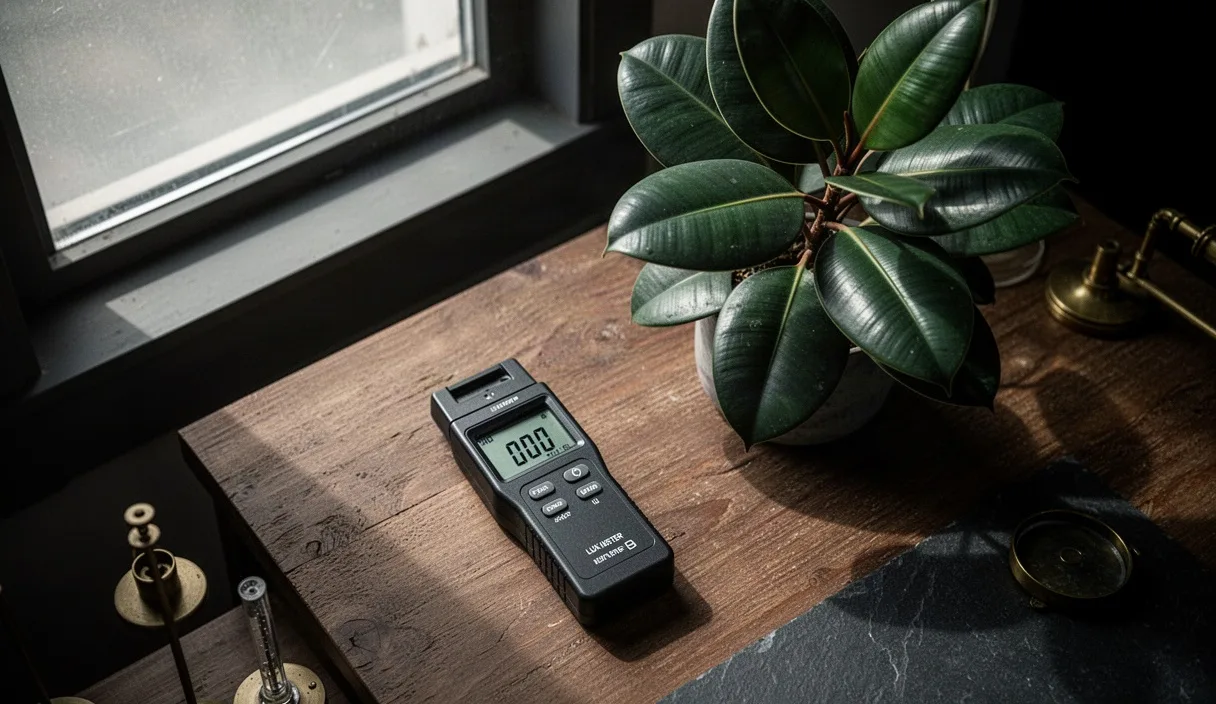
You will learn how to measure indoor photosynthetic light using an inexpensive digital lux meter rather than relying on human visual estimates. Follow these baseline measurements to position foliage plants according to their physiological compensation points.

- Visual estimation of indoor light usually overestimates usable energy by a wide margin.
- Aroids and marantaceae maintain steady growth at 150 to 300 foot-candles for ten hours daily.
- Standard window glass and distance reduce light intensity according to the inverse-square law.
Indoor lighting calibration requires standardizing measurements of illuminance. A foot-candle measures the illuminance of one lumen falling across one square foot, whereas one lux measures one lumen across one square meter. Because one square meter equals 10.76 square feet, multiplying foot-candles by 10.76 yields the equivalent lux. In controlled indoor cultivation, basic photometers offer rapid diagnostics, but growers must account for the mechanical divergence between human optical perception and botanical photochemical requirements.
Divergence Between Human Vision and Photosynthetic Radiation
Human vision responds to the photopic curve, which peaks near 555 nanometers in the green portion of the spectrum. Plants rely instead on photosynthetically active radiation spanning 400 to 700 nanometers, driven primarily by chlorophyll a and chlorophyll b absorption bands in the blue and red wavelengths. Broad-spectrum daylight and white ceramic fixtures maintain a consistent ratio between photometric units and photosynthetic photon flux density. Conversely, narrow-band spectrum sources like blue and red diode fixtures distort lux readings, resulting in photopic values that significantly underrepresent available metabolic energy. Standard lux meters are reliable proxies under unshaded natural daylight, but they require recalibration factors under specialized horticultural fixtures.
Converting Lux and Foot-Candles to Target Plant Ranges
Illuminance requirements correspond directly to an indoor plant species native canopy layer and evolutionary adaptation. The following operational ranges guide placement:
- Low-light tolerant taxa (such as Epipremnum aureum and Aspidistra elatior): 800 to 1,600 lux (75 to 150 foot-candles).
- Moderate understory taxa (such as Monstera deliciosa and Ficus elastica): 1,600 to 4,500 lux (150 to 420 foot-candles).
- Direct canopy and fruiting taxa (such as citrus cultivars and Mediterranean herbs): 4,500 to 10,800 lux (420 to 1,000 foot-candles).
Mapping Natural Light Falloff from Glass Windows
Natural illuminance attenuates rapidly as the distance from an aperture increases. Although the inverse-square law applies strictly to point sources in non-reflective vacuum environments, window apertures exhibit steep geometric falloff. For example, a south-facing aperture yielding 4,300 lux at a distance of 0.3 meters frequently drops below 1,100 lux at a distance of 1.2 meters. Glazing composition also modifies transmission: modern double-pane glass with low-emissivity coatings reduces incident radiation by 25% to 40% relative to exterior values. When mapping a perimeter, record values with the meter sensor oriented horizontally at foliage height during solar noon on an overcast day to eliminate momentary direct solar beam spikes.
Adjusting Placement to Prevent Leaf Chlorosis or Etiolation
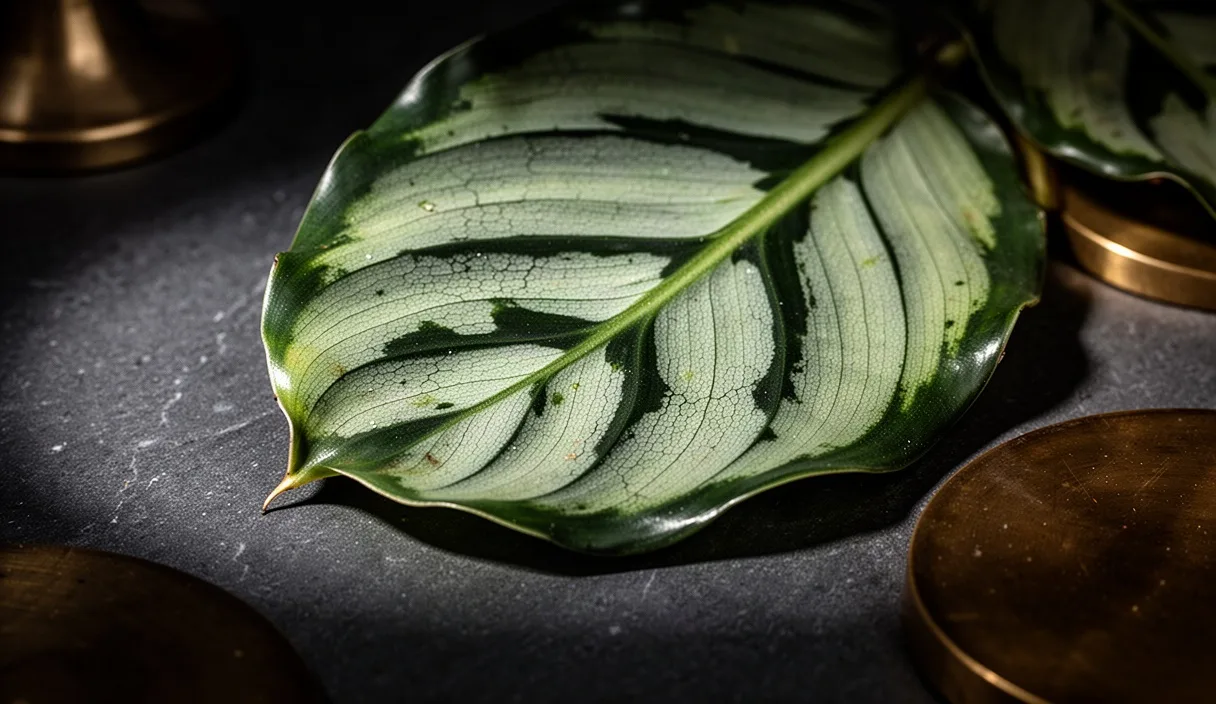
Mismatched illuminance causes distinct physiological disorders. Etiolation occurs when deficient photon flux forces cell elongation, resulting in elongated internodes, compromised vascular rigidity, and reduced pigment density. When monitored values fall below 600 lux for more than fourteen consecutive days, relocate the specimen inward toward the light cone. In contrast, excessive photon flux overwhelms the photosynthetic electron transport system, inducing photobleaching chlorosis. This condition presents as bleached patches and desiccated marginal tissue. When sustained midday values exceed species thresholds by 30% for three consecutive hours, deploy a sheer diffuser or adjust the horizontal position outward by 0.5 meters.
To establish a functional baseline, log illuminance across morning, midday, and late afternoon intervals over three consecutive days. For commercial installations, public atriums, or indoor facilities exceeding 80 square meters, consult a certified horticultural lighting specialist to model daily light integrals with calibrated quantum flux meters.
This documentation serves educational purposes; consult an accredited horticulturist or agricultural extension service for severe quarantine pests or structural plant risks. Disclaimer