 Mekounone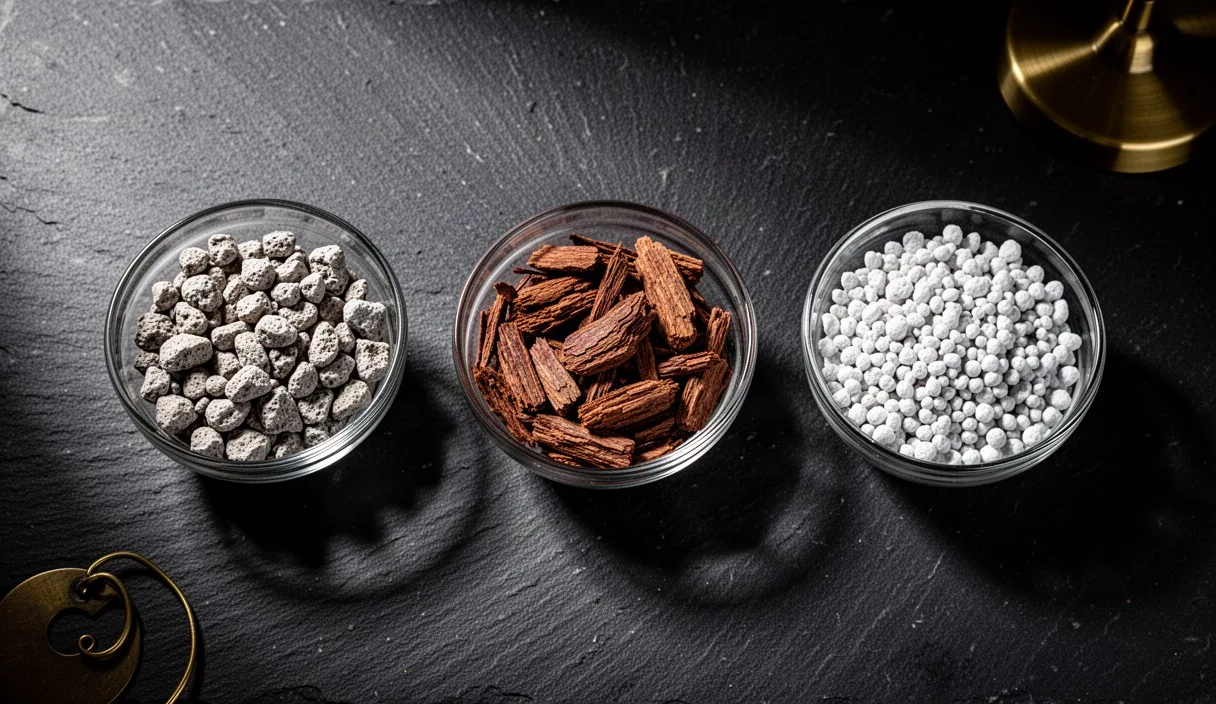
You will be able to blend a porous, structural potting mix from pine bark, pumice, and perlite. This structure prevents anoxic zones around roots while maintaining balanced moisture retention between watering events.

- Coarse aggregates ensure air fills critical pore space immediately after complete water saturation.
- Pine bark provides structural stability for several seasons before decomposition alters pH levels.
- Rinsing pumice and perlite beforehand prevents fine particulate sediment from clogging drainage ports.
An inorganic aroid substrate is a non-soil growing medium composed entirely of mined, fired, or crushed mineral aggregates. Unlike traditional peat-based or bark-based mixes, inorganic components do not decompose, acidify through microbial action, or shrink over extended cultivation cycles. Formulating such a mix requires balancing capillary water retention against gas exchange. For epiphytic and hemiepiphytic aroids such as Monstera, Philodendron, and Anthurium, this balance is governed by the volume and distribution of macro-pores within the container.
The Physical Role of Macro-Pores in Root Respiration
Macro-pores are empty voids between substrate particles that measure greater than 0.08 millimeters in diameter. In container culture, gravity clears water from these larger voids within seconds of saturation, leaving channels filled with ambient air. Aroid roots exhibit high respiration rates and require an oxygen diffusion rate that prevents anaerobic conditions in the root core. If macro-pore volume drops below 22% of total container volume, carbon dioxide accumulates around root tissue, inhibiting metabolic activity and predisposing the root cortex to infection by waterborne oomycetes such as Pythium.
Achieving this target void space depends directly on aggregate sizing and uniformity. Particles should measure between 4 millimeters and 9 millimeters across. Blending aggregates below 3 millimeters fills the interstitial voids, creating a perched water table where capillary suction overpowers gravity. A reliable baseline formulation combines three distinct materials:
- Pumice (fraction: 4 to 8 millimeters) for low density and balanced internal porosity.
- Zeolite or calcined clay (fraction: 3 to 6 millimeters) to provide cation exchange capacity without structural breakdown.
- Expanded shale or scoria (fraction: 5 to 10 millimeters) to maintain a rigid, non-crushing structural matrix.
Washing and Pre-Conditioning Porous Media
Raw aggregates contain mineral dust, fractured silt, and variable baseline soluble salts. These fine particles migrate to the base of the container during irrigation, forming a dense sludge that occludes lower drainage openings. Screen dry aggregates over a 3-millimeter stainless wire mesh to eliminate sub-millimeter fines. Rinse the screened medium with clean water until the electrical conductivity of the runoff matches that of the input water within 0.05 millisiemens per centimeter. Conclude by soaking the washed aggregates in a weak calcium nitrate solution (0.4 grams per liter) for 18 hours to displace excess sodium ions from internal mineral binding sites.
Once established in containers, inorganic media must be monitored for drainage velocity and particle segregation. A properly graded mineral column should accept an irrigation dose equivalent to 35% of the pot volume without standing water pooling on the surface for longer than 4 seconds. Because inorganic particles do not rot, compaction occurs primarily through mechanical settling or the accumulation of sloughed root sheaths. If irrigation effluent becomes cloudy or takes longer than 15 seconds to discharge through bottom drainage holes, mechanical flushing from above is necessary to purge organic debris from the aggregate voids.
Growers should systematically verify nutrient solution compatibility before transferring valuable specimens into pure mineral culture. Because inorganic mixes lack native organic buffering, every irrigation event directly dictates the root zone pH and electrical conductivity. Calibrate your dosing systems to supply complete, nitrate-dominant nutrient formulations at an electrical conductivity between 0.8 and 1.3 millisiemens per centimeter, and consult a professional agricultural laboratory if leaf tissue analysis shows unexpected micronutrient antagonisms.
This documentation serves educational purposes; consult an accredited horticulturist or agricultural extension service for severe quarantine pests or structural plant risks. Disclaimer